Monday, May 16, 2011

Atari Punk Manifesto

.....AAA TTTTTT AAA   RRRR   IIIIII   PPP   UU   UU  NNN   NN  KK  KK
...AA AA TT AA AA RR RR II PP PP UU UU NNNN NN KK KK
..AAAAA TT AAAAA RRRR II PPPP UU UU NN NN NN KKKK
.AA AA TT AA AA RR RR II PP UU UU NN NNNN KK KK
AA AA TT AA AA RR RR IIIIII PP UUUUU NN NNN KK KK

ATARI PUNK MANIFESTO
1 Retrocomputing is useless, but that just makes it better
10 Obfuscation is a legitimate aesthetic choice
11 Strange haircuts, cardboard guitars, and computer samples
100 Cyberpunk was more fun when it was divorced from reality
101 New Wave is punk with synthesizers, but we love you anyway
110 All that we are is all that we need to be
111 All that we know is human machinery
1000 64k isn't enough for anyone, but it's more than enough for us
1001 There was a time when men were men, women were men, and children wrote their own device drivers
1010 We aren't nostalgics; we just play them on TV
1011 Our rear view mirrors are neon pink, unironically
1100 It's too much machine for you
1101 Paper is accordion-folded, and 3d is in wireframes
1110 Acoustic couplers make sweet music
1111 Mice? Where we're going, we don't need mice.

Saturday, May 7, 2011

Sublim experiment rundown

Back in the day (2006 or 2007), after several years of experimentation, I coauthored a document about the use of visual subliminal messages (specifically those produced by the xscreensaver package's xsublim program) for cognitive enhancement. It hasn't aged terribly well, and I'm rather embarrassed now by the writing style, but every so often someone contacts me asking whether or not I have continued experimentation. The answer is yes. I figure now is as good a time as any to give you the run-down on my later experiments.

As a first note, I am not experimenting with subliminal advertising. If you are looking for something about subliminal advertising, rocketboom has a good video on the subject, after which you will require no other materials.

At the time of writing the original document, I had a model of the mechanism involving chain reactions of primed ideas. This may still be relevant, but there are other (more down-to-earth) attributes of the process with more literature within the field of cognitive psychology to back them up. While subliminal messages do not give a strong enough priming to significantly influence behavior in the context of advertising (or rather, they don't have the property claimed of homeopathy: subliminals are not more powerful the less they are observed), subliminal messages have been shown to affect the sense of familiarity. In situations where unfamiliarity with terminology, wording, or notation is a major stumbling block, being subliminally primed with the terminology in question can act as a gentle introduction, making the terminology no longer seem arbitrarily difficult and frightening. By producing a false sense of familiarity with the subject matter, the subject matter seems easier to pick up.

Another idea (which is strongly influenced by the excellent book The Art of Memetics) is that mental blinders (and other psychological biases that prevent the absorption of unfamiliar or conflicting information) can be modeled as the defense mechanisms of dominant memeplexes. These memeplexes subvert, assimilate, or deny newcomers since new ideas can compete with the old ones. Subliminal messages allow slow and subtle subversion by all memeplexes, regardless of whether or not they conflict with existing ones. As a result, use of subliminals can decrease the likelihood of decisions being unduly biased by unseen socially reinforced heuristics, so long as documents whose dominant underlying assumptions differ conflictingly have their words primed.

So, above we have some new models for the mechanism of action. Furthermore, new attributes have been discovered.

The physiological effects of sublims are highly dependent upon the novelty of the content. A single static document of arbitrary length will quickly cease to be enough for sublims, eventually giving none of the symptoms at all. As the use of sublims increases, necessary novelty does not increase linearly but exponentially. I currently use more than twenty gigabytes of static plaintext as a small part of my sublim input, balanced out by semi-static input (fortune databases), significantly more dynamic input (mostly via the random page feature in mediawiki installations), and less structured 'noise' input (text generated from markov models of other documents, text generated by piping other inputs through rhyme generators and other filters, text generated using context-free grammars). Too much novelty (trying to sublim with a four gigabyte video interpreted as ascii text, say) is not physiologically pleasant.

Sublims have different effective novelty ranges given different mental states. Stimulants appear to raise the required novelty level. Depressants appear to lower the maximum novelty level, but occasionally they cause the sublims to have absolutely no effect. Binaural entrainment at theta range frequencies appears to maximize the physiological effects for as long as the entrainment is occurring, but when the pattern stabilizes the physiological effects disappear.

Finally, there are a few technical updates.

Xsublim is no longer maintained by the xscreensaver project, and if you install a modern version of xscreensaver xsublim will not be installed. The last time I checked, the xsublim source was part of the source tarball but could not be trivially coaxed to compile. I have been using an old binary copied from an earlier release.

I have used the xosd package to write a clone of xsublim, called asublim. It does not operate precisely the same way. Where xsublim caches the full run of the program from which it takes its input before displaying anything, asublim caches each space-separated token smaller than 512 bytes (and cuts those larger into 512 byte pieces) and displays them in real time. As a result, asublim starts more quickly but is also more sensitive to load fluctuations. When I have used it, the asublim program itself is significantly slower than most of the programs feeding it, and so I have not had pipe underflows or noticeable delays. Asublim does not currently have support for the various command line options that xsublim supports, though support for most of them can be implemented. Asublim also has a few glitches: the self-erasing feature appears to operate differently from xsublim's implementation, and so on programs (such as firefox) that are slow to redraw their window bitmap there is a tendency for already erased tokens to obscure the contents of the canvas. I have not duplicated this problem on anything other than firefox.

If you have found this post by researching the terms found in the original Infornography document, please post your comments here rather than looking me up.

Wednesday, April 27, 2011

Time Binding, or why the past isn't what it used to be

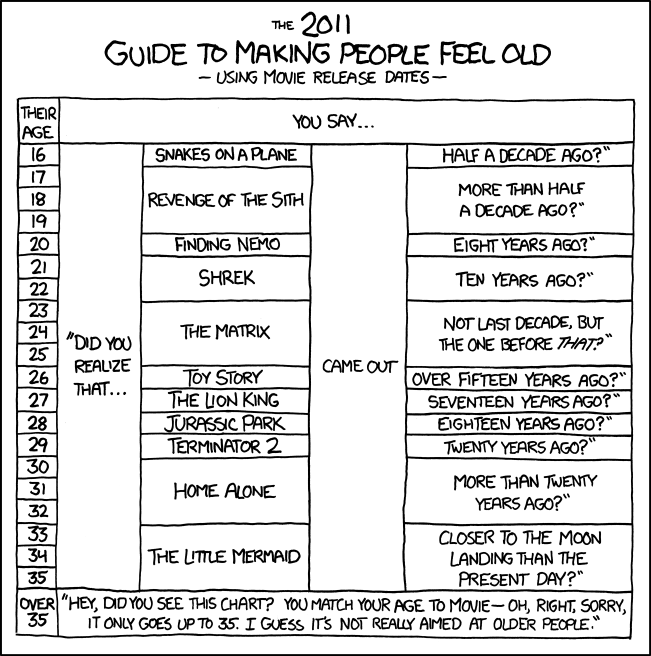
Today's XKCD reminded me of a fairly interesting effect called time binding. The term was coined by Alfred Korzybski. This is how Wikipedia defines it:
Time binding: The human ability to pass information and knowledge between generations at an accelerating rate. Korzybski claimed this to be a unique capacity, separating us from other animals. Animals pass knowledge, but not at an exponential rate, that is to say, each generation of animals does things pretty much in the same way as the previous generation. For example, at one time most human societies were hunter-gatherers, but now more advanced means of food production (growing, raising, or buying) predominate. Excepting some insects (for example, ants), all other animals are still hunter-gatherer species, even though many have existed longer than the human species.Source

Among the people to work with the concept of time binding are Marshal McLuhan and Robert Anton Wilson.

One of the fundamental results of time binding (and the source of the term) is that when you record information in this way, you lower the amount of distortion done to it by natural processes over a given span of time. By doing this, you make that particular piece of information more available to people in the future (or available to people further in the future). Because of the availability bias, information that is more familiar seems to some extent more current, in the sense of seeming more (currently) true. So, time binding, though it does not slow down time, slows down time perception of the past, creating a mental 'now' that extends further into the past. This makes rear view mirror thinking not only easier to do but easier to get away with.

Among the many things the widespread adoption of the internet has done for us is made a significantly greater quantity of significantly more trivial information significantly more available to a significantly greater quantity of people significantly less familiar with the subject matter. The widespread adoption of the internet has also made it easier for people like the archive team to save information that would have otherwise been lost. So, in other words, someone living in a bubble on Mars in 2525 can read the tweet you sent yesterday about what you were having for breakfast. Because of time binding, that tweet will seem significantly less old to that Martian bubble-boy than anything written in 1476 will seem to you.

Nearly everyone born in the industrialized west in the twentieth century, aside from the very poor and those living in anomalously technically retrogressive communities, is not only intimately familiar with but is involved with the franchise of some media created shortly before their own birth. There are many Star Wars fans who weren't born until after the last episode of the original trilogy was released, and probably some who weren't born until all of the current canon films were released. There are even more fans of the Lord of the Rings trilogy who were not alive when they appeared in paperback, let alone when they were written. Some classic rock fans who lived through the latter end of the era (and were actively consuming the release of, say, Pink Floyd's The Final Cut) were not alive for the early releases (such as Pink Floyd's Atom Heart Mother). Does The Final Cut sound old? Does The Empire Strikes Back feel like an old film? Neuromancer was written six years before I was born, but it still feels fresh. A piece of media feeling old has never had to do with its actual age; it has always been the gradual decay of information about it. With the increase in storage space, communications speed, and fidelity, we slowly extend our 'now' behind us in time, like a comet's tail.

Tuesday, April 26, 2011

More unpatched exploits in the human biocomputer

Fallacies underlying morality in hierarchical systems

One of the big arguments against pure voluntarism as a stable political system is that people tend to form hierarchies. Indeed, people do tend to form hierarchies. One of the reasons for this is Dunbar's number. This post will not cover that topic. I want to instead focus on what I consider the other major reason that human groups tend to fall into hierarchy.

There are two meta-moral systems (which is to say, categories of moral systems) involved with dominance and submission. One is that described by Nietzsche, who called it the 'slave morality'. The other I will call the 'slavemaster morality'.

In the slave morality, there is one major heuristic: the victim (or the person in the submissive position) is always morally in the right. He or she has been put upon unduly by the dominant party, and bears no responsibility for the problems. In a system of pure 'slave morality', the old 'just following orders' excuse always flies.

In the slavemaster morality, there is one major heuristic: the person who has taken charge is morally in the right, because something must be done. Those who have abdicated responsibility may be taken advantage of freely, because they have surrendered their choice. It is rarely put into these terms.

Mosbunall of those with the slave morality see mosbunall those with the slavemaster morality as evil greedy fascists. Mosbunall of those with the slavemaster morality see mosbunall of those with the slave morality as evil greedy parasites.

The funny thing is, slave morality and slavemaster morality are strangely entwined. Slave morality, with its abdication of responsibility in exchange for shielding from being morally in the wrong, requires those with the slavemaster morality to take charge of them. Slavemaster morality cannot survive in the absence of willing slaves. The symbiosis is fairly clear.

Not only are these two metamoral systems symbiotically linked, but they are based on the same pair of fallacies. They both take as absolutely true that:
  1. it is undesirable or unpleasant to be submissive,
  2. and
  3. it is desirable or pleasant to be dominant

These heuristics are rarely accurate. Dominance bears the burden of responsibility, not only for the self but also for others. Submission removes this burden. While there are positives to dominance (it helps one get one's way, for instance) and negatives to submission (abdicating control has many psychological impacts in addition to making it problematic to have one's needs reliably met), in general one state of affairs is not on the whole significantly better than the other. So, anyone who takes the above heuristics as absolutely true will subscribe to slave or slavemaster morality depending on whether they want to abdicate responsibility or gain power, respectively.

I suspect that these heuristics predate the dawn of man as such. Hierarchical behavior in packs of nonhuman primates sometimes follows the same pattern. In a system with communication limited in speed and complexity, there are extreme benefits to having a single leader, and the above-mentioned heuristics encourage the selection of a more nearly optimal leader over time, as well as discouraging mutiny by those not predisposed to a dominant position. But, I hope we have progressed far enough that we can attempt to overcome these biases with reason and endeavor to live in a society not essentially based on the structure of gangs of roving gorillas.

Tuesday, April 19, 2011

Ludibrium as weapon

Filed under the plans I approve of dept.:
In summary, several Chinese language, but overseas based, websites have been blogging on the creation of a ‘Jasmine Revolution’ in China. [...] The blogs and websites themselves are largely invisible to ordinary Chinese as the Great Firewall keeps them out, but they can be seen by the security agencies, who have been swift to react. The organizers, whoever and wherever they are, have repeatedly called on people to gather in a range of popular and public areas in the centre of major cities across China – shopping malls and university campuses – and go for a stroll every Sunday afternoon to call for minor political change. These public areas are, at that time of day, normally filled with young people and out-of-town domestic tourists, all now potential ‘protesters’. Now, because of the number of competing and overlapping security agencies, there is a lot of pressure on the local commanders to make some arrests and to show some success, but there are no genuine protesters, just some bemused local tourists and a lot of foreign journalists. [...] At the same time, the organisers have used a wide range of popular and politically ‘safe’ words to use as code words [...] These keywords get picked up by the censors, and all web and SMS traffic using them gets shut down or blocked – Jasmine itself is of course popular in Chinese culture and widely used in branding, but sites using ‘Jasmine’ in their copy, however innocuous, are blocked - with real-world social, political and economic consequences.
source


The use of a fake revolution to foment a real revolution reminds me of the Rosicrucians, who never existed. The original documents attributed to the Rosicrucians were later claimed, by their author, to be a hoax. By introducing a secret society so desirable, pretenders were attracted, who then claimed to be members and inducted new members who weren't in on the fact. These members inducted new members, and soon a set of completely different secret societies were formed with the same name and claiming the same lineage. But, unlike the rosicrucian ludibrium, this plan requires the paranoid chinese secret police to play their part -- which is to say it's only useful against a government that is extremely paranoid about the possibility of revolution.

While there are innocents getting hurt because of this, it's not comparable to a revolution or an invasion -- or even a real protest. Nobody's bringing in tanks.

That said, this still brings up the question of memetic warfare. This is not (as far as I can tell) a CIA operation, though the CIA does things like this fairly frequently. This appears to be a psyops project being performed by individuals, which is why it appeared on the globalguerillas blog. It remains to be seen whether or not this is effective, though as the comments thread indicated, the chinese economy is suffering, which may be related to the blocking of keywords associated with otherwise profitable things. But, it's the first example I've seen of a memetic warfare operation performed by individuals upon an entire government and its auxiliary support mechanisms without requiring budget with some level of success.


Edit: China is clearly no stranger to the infictive in politics. NB: Since I do not live in China, I cannot make arguments about quality of life issues there, so I do not have any confidently-held quality judgments about their methods in terms of the perspective of a citizen. I am sure that many chinese citizens think that the united states is a horrible totalitarian government and that US citizens are much less 'free' than they are. I don't know who discovered water, but it wasn't the fish.

Sunday, April 3, 2011

Words that don't mean what you think they mean, part 1: outlaw

The word: Outlaw
What you think it means: criminal
What it really means: someone immune to prosecution

Wait, what?
In historical legal systems, an outlaw is a person declared as outside the protection of the law. In pre-modern societies, this takes the burden of active persecution of a criminal from the authorities. Instead, the criminal is withdrawn all legal protection, so that anyone is legally empowered to persecute or kill them. Outlawry was thus one of the harshest penalties in the legal system, since the outlaw had only himself to protect himself, but it also required no enforcement on the part of the justice system. In early Germanic law, the death penalty is conspicuously absent, and outlawing is the most extreme punishment, presumably amounting to a death sentence in practice.
Source: wikipedia
In other words, an outlaw is someone who has committed a crime so heinous that even the people who hunt down criminals for a living no longer want anything to do with him. They declare him an outlaw, and so not only do they no longer need to prosecute him for further crimes, but they don't have to defend him from other criminals. By reserving this treatment for only the most dangerous of criminals, it simultaneously almost guarantees that the outlaw will be killed (either by law-abiding vigilantes or by other criminals), and also reinforces the idea within the culture that a lawless society is dangerous (because everyone who is an outlaw is a particularly dangerous criminal).

Wednesday, March 30, 2011

Two varieties of anarchist sentiment

There are many ways to categorize anarchist groups, and many systems of categorization are in conflict. This will not be covered in this blog post, because not only am I not an expert in the history of internal ideological schisms within anarchist philosophy, but I am more or less uninterested in the politics of anti-politics. Instead, I am categorizing anarchist sentiment more grossly, into two large chunks.

There is one type of anarchist who believes that anarchy is something to be achieved. Maybe it's something that was lost in the genesis of the first state. Maybe it's something that has never been tried, or never been attempted seriously. Maybe it's something that has been tried but has been crushed by statist forces external to itself. The bottom line is that this type of anarchist considers anarchy to be something that isn't, but should be.

There is another type, far less visible. This type considers anarchy to be omnipresent already, at the base of things. All states are structures built on top of anarchy, and obscuring it. The goal of this type of anarchist is not to bring anarchy into being but to make people aware that they have always lived in anarchy, and that this isn't a bad thing. This type of anarchist sentiment is in a sense even more subversive, and even more dangerous to the state. The first type can be pitted against the state in a kind of imaginary war of ideas, and can be manipulated to give statism even more ideological power; the stereotype of a bomb-throwing adolescent lifestyle anarchist is always accepting the existence of the state and by working against it reinforces the sense of its power. A state, however, cannot effectively fight a war of ideas against those who believe the state itself to be imaginary, nor can it effectively be seen to fight against a system of which it is a small part.

For a long time, I thought the second type was extremely rare, rather than merely underrepresented. Today, I saw a quote on the liberationfrequency tumblr:
Anarchy is every time you share a stick of gum. Every time you help someone with their homework, or with their bags. Every time you hold a door for a stranger. Every wallet returned to the lost and found. Every borrowed cup of sugar. Every driveway you helped shovel. Anarchy is people helping people not for the glory but for each other. Anarchy is for the people by the people; not this ballot-box nonsense. Anarchy is you and me... on the purest of all levels.
This is very much the essence of the second type, which I term epistemic anarchy. You could consider epistemic anarchy a subset of voluntarism, but it differs in that it talks about what is rather that what should be.

Keep in mind that this is also a key difference between Gnostic and mainstream Christianity, between Zen Buddhism and several other flavours, and between many forms of mysticism and those traditions that present the same texts and myth systems to mundanes. The difference is between going to heaven if you are good and being good in order to remember that you are already in heaven. The former makes people fairly easy to manipulate, but the latter is more difficult to impart to people. Mystical traditions often actively turn down the induction of people who they don't think are capable of fundamentally grasping the latter, in order to avoid the mutation of their tradition.

Tuesday, March 15, 2011

Energy drinks and I^2

Much has been made (mostly by Malcolm Gladwell, which isn't necessarily a stunning endorsement) of the connection between the enlightenment and the broad use of coffee in Europe. Coffee houses were about the only social gathering place where people were taking stimulants rather than depressants, and so they were extremely productive intellectual centers. This post will not discuss the social aspect except in passing, but I will be spending part of it claiming that energy drinks are better than coffee so I figured I'd get that out of the way. (Full disclosure: I hate coffee with a passion, so I am biased.)

Today, the social aspect of coffee houses has atrophied. Coffee houses aren't really meetingplaces anymore. The same amount of socializing taking place in coffee houses is taking place on the internet, and most of the socializing in coffee houses takes place on the internet anyway. All we have that remains is the caffeine, and that is now taken care of by other methods.

What do energy drinks have that coffee does not? I'm not counting things like b vitamins or taurine, or horny goat weed, or any of the other various and sundry ingredients that are hyped. Most of them don't have well-documented results, and they all balk in nootropic function in comparison to something else that's common to all energy drinks: a wide variety of types, most of them disgusting.

Bear with me here. There has been a lot of talk (and several seemingly legitimate studies) about the correlation between intelligence and novelty-seeking behavior. Most of the people who know the difference between correlation and causation seem to assume that intelligence causes novelty-seeking, and perhaps it does. I would go for the opposite explanation, however: those behaviors which we consider intelligent are largely the product of a novelty-seeking disposition. Someone can be extremely innately intelligent, skilled, and clever, and they can still be so stuck on a single model of the world that they avoid any activity that we'd consider the hallmark of a great intellect. Someone can be innately fairly dull, but through a drive to learn about the world come off as intelligent. One of the things an area like energy drinks encourages is novelty seeking behavior.

The likelihood of the first energy drink someone tries being tasty is minimal, but the likelihood of it being highly caffeinated is great. The moment someone tastes it, two things happen: he realizes that it's disgusting, and he is rewarded for trying it. He may not want to try that particular variety again for a while, but there are plenty on the shelf, and when he tries the next one the same thing happens. By exploring the many varieties of energy drinks he is performing operant conditioning on himself to become a novelty-seeker.

From what I understand, this was something like the state of coffee houses in London in the nineteenth century -- most of the coffee was terrible but still caffeinated, and you had to do a lot of exploring of the city to find a coffee house that served edible coffee. This may partially account for the success of Babbage and Lovelace, among others.

Tuesday, March 1, 2011

Increasing Signal to Noise Ratio in Markov Chain Output

The usual way of doing a markov chain bot (first order) is that for all pairs of tokens p and q, the likelihood of p following q is:

P(q|p)
P(p)

This gives us a probability graph that looks more or less like a line. The most common pairs are up top, and the least common are at the bottom. This is actually directly equivalent to the inverted graph of information entropy, where the least common would be up top and the most common at the bottom.

The problem is that in language, the most common sequences tend to be meaningless (or exist only for redundancy). Search engines filter these sequences out because they do nothing but make more work for systems that operate based on finding the sequences closest to unique. The outliers on the other side tend also to be meaningless, for a different reason: they tend to be errors. So, the optimal signal is actually of middling entropy.

How do we make bots that will (without special-case coding) automatically avoid succumbing to the usual exploits (such as the twelve year old troll who spams it in PM with the token “mantits” repeated eleven thousand times)? How do we reliably and elegantly improve the signal to noise ratio?

If you try to graph how likely something is to be signal-heavy in such a system, you’ll probably get a parabola that peaks about where the graph of probability and the graph of entropy cross. The goal is to make the graph of this weighted markov probability (which might be called cooked-model probability) quickly approach that of the signal. The easiest way to do this is, rather than incrementing both p and q when p follows q, doing the following:

Pn(q|p) <- Pn-1(q|p) + ((Pn-1(q|p))2-(Pn-1(p))2)1/2

Pn-1(p)

Pn-1(q|p)

Pn(p) <- Pn-1(p) + 1

As should be clear, the graph will rapidly approach resemblance to the signal graph, and it will slow its mutation as it gets closer to the signal graph, for a known sequence of tokens. This means that such a bot should be capable of operating at a similar signal to noise ratio as some standard with a much smaller training input set.


graph of raw markov model of phrack

Wednesday, February 23, 2011

Libertarian distcomp projects: solutions in search of problems

There have been several projects floating around involving distributed computing in a non-charity context. Unlike the charity-type distcomp projects like SETI@Home, distributed.net, Folding@Home, and friends, people who donate computing resources to these get something in return. The general form for this is: a token has the value of a certain number of operations, and also a value in some real-world currency. Someone can spend tokens in exchange for processing, or exchange them with real money, and people whose machines perform processing get tokens in exchange. It seems very straightforward.

The problem is, it's entirely useless.

The kinds of problems that can be trivially distributed are few and far between. There's cryptanalysis, protein folding, gene sequencing, the kind of rank-computing that gets done at google's data centers on hadoop... Most of the CPU-intensive tasks that one can list off are either also very data-intensive (huge data sets are easier to handle in-house than to send flying across the world, especially when the smallest chunks you can deal with are a couple hundred megs) or of no interest to anyone outside of academia (and thus worth very little money) -- in other words, video encoding and finding primes are out of the picture. We're left with things like cryptanalysis, which is somewhat problematic since the people willing to spend money to bruteforce encryption are probably either spooks or crooks (and the spooks have their own machines for this kind of thing).

I'd absolutely love to run this kind of system, because I'm wasting plenty of cycles at home and I'm not getting any richer. If any of you can think of a problem that would be a good fit for this solution, *please* let me know. I'll give you a million free cycles on my new distcomp network.

Saturday, December 18, 2010

Too bad they don't follow it


Turns out that the Committee for Skeptical Inquiry (whose capacity for skeptical inquiry has historically left me unimpressed) actually has a set of guidelines for proper skeptical criticism, and it's not bullshit!


During CSICOP’s first decade of existence, members of the Executive Council often found themselves devoting most of their available time to damage control-precipitated by the careless remarks of fellow skeptics-instead of toward the common cause of explaining the skeptical agenda.

Unfortunately, at this time, there are no courses on the proper way to criticize paranormal claims. So far as I know, no manuals or books or rules are currently available to guide us. Until such courses and guide books come into being, what can we do to ensure that our criticisms are both effective and responsible?

I would be irresponsible if I told you I had an easy solution. The problem is complicated and there are no quick fixes. But I do believe we all could improve our contributions to responsible criticism by keeping a few principles always in mind.

We can make enormous improvements in our collective and individual efforts by simply trying to adhere to those standards that we profess to admire and that we believe that many peddlers of the paranormal violate. If we envision ourselves as the champions of rationality, science, and objectivity, then we ought to display these very same qualities in our criticism. Just by trying to speak and write in the spirit of precision, science, logic, and rationality-those attributes we supposedly admire-we would raise the quality of our critiques by at least one order of magnitude.

The failure to consistently live up to these standards exposes us to a number of hazards. We can find ourselves going beyond the facts at hand. We may fail to communicate exactly what we intended. We can confuse the public about what skeptics are trying to achieve. We can unwittingly put paranormal proponents in the position of the underdogs and create sympathy for them. And, as I already mentioned, we can make the task much more difficult for other skeptics.

What, then, can skeptics do to upgrade the quality of their criticism? What follows are just a few suggestions. It is hoped they will stimulate further thought and discussion.
  1. Be prepared.

    Good criticism is a skill that requires practice, work, and level-headedness. Your response to a sudden challenge is much more likely to be appropriate if you have already anticipated similar challenges. Try to prepare in advance effective and short answers to those questions you are most likely to be asked. Be ready to answer why skeptical activity is important, why people should listen to your views, why false beliefs can be harmful, and the many similar questions that invariably are raised. A useful project would be to compile a list of the most frequently occurring questions along with possible answers.

    Whenever possible try your ideas out on friends and “enemies” before offering them in the public arena. An effective exercise is to rehearse your arguments with fellow skeptics. Some of you can take the role of the psychic claimants while others play the role of critics. And, for more general preparation, read books on critical thinking, effective writing, and argumentation.

  2. Clarify your objectives.

    Before you try to cope with a paranormal claim, ask yourself what you are trying to accomplish. Are you trying to release pent-up resentment? Are you trying to belittle your opponent? Are you trying to gain publicity for your viewpoint? Do you want to demonstrate that the claim lacks reasonable justification? Do you hope to educate the public about what constitutes adequate evidence? Often our objectives, upon examination, turn out to be mixed. And, especially when we act impulsively, some of our objectives conflict with one another.

    The difference between short-term and long-term objectives can be especially important. Most skeptics, I believe, would agree that our long-term goal is to educate the public so that it can more effectively cope with various claims. Sometimes this long-range goal is sacrificed because of the desire to expose or debunk a current claim.

    Part of clarifying our objectives is to decide who our audience is. Hard-nosed, strident attacks on paranormal claims rarely change opinions, but they do stroke the egos of those who are already skeptics. Arguments that may persuade the readers of the National Enquirer may offend academics and important opinion-makers.

    Try to make it clear that you are attacking the claim and not the claimant. Avoid, at all costs, creating the impression that you are trying to interfere with someone’s civil liberties. Do not try to get someone fired from his or her job. Do not try to have courses dropped or otherwise be put in the position of advocating censorship. Being for rationality and reason should not force us into the position to seeming to be against academic freedom and civil liberties.

  3. Do your homework.

    Again, this goes hand in hand with the advice about being prepared. Whenever possible, you should not try to counter a specific paranormal claim without getting as many of the relevant facts as possible. Along the way, you should carefully document your sources. Do not depend upon a report in the media either for what is being claimed or for facts relevant to the claim. Try to get the specifics of the claim directly from the claimant.

  4. Do not go beyond your level of competence.

    No one, especially in our times, can credibly claim to be an expert on all subjects. Whenever possible, you should consult appropriate experts. We, understandably, are highly critical of paranormal claimants who make assertions that are obviously beyond their competence. We should be just as demanding on ourselves. A critic’s worst sin is to go beyond the facts and the available evidence.

    In this regard, always ask yourself if you really have something to say. Sometimes it is better to remain silent than to jump into an argument that involves aspects that are beyond your present competence. When it is appropriate, do not be afraid to say, “I don't know.”

  5. Let the facts speak for themselves.

    If you have done your homework and have collected an adequate supply of facts, the audience rarely will need your help in reaching an appropriate conclusion. Indeed, your case is made much stronger if the audience is allowed to draw its own conclusions from the facts. Say that Madame X claims to have psychically located Mrs. A’s missing daughter and you have obtained a statement from the police to the effect that her contributions did not help. Under these circumstances it can be counterproductive to assert that Madame X lied about her contribution or that her claim was “fraudulent.” For one thing, Madame X may sincerely, if mistakenly, believe that her contributions did in fact help. In addition, some listeners may be offended by the tone of the criticism and become sympathetic to Madame X. However, if you simply report what Madame X claimed along with the response of the police, you not only are sticking to the facts, but your listeners will more likely come the appropriate conclusion.

  6. Be precise.

    Good criticism requires precision and care in the use of language. Because, in challenging psychic claims, we are appealing to objectivity and fairness, we have a special obligation to be as honest and accurate in our own statements as possible. We should take special pains to avoid making assertions about paranormal claims that cannot be backed up with hard evidence. We should be especially careful in this regard when being interviewed by the media. Every effort should be made to ensure that the media understand precisely what we are and are not saying.

  7. Use the principle of charity.

    I know that many of my fellow critics will find this principle to be unpalatable. To some, the paranormalists are the “enemy,” and it seems inconsistent to lean over backward to give them the benefit of the doubt. But being charitable to paranormal claims is simply the other side of being honest and fair. The principle of charity implies that, whenever there is doubt or ambiguity about a paranormal claim, we should try to resolve the ambiguity in favor of the claimant until we acquire strong reasons for not doing so. In this respect, we should carefully distinguish between being wrong and being dishonest.

    We often can challenge the accuracy or validity of a given paranormal claim. But rarely are we in a position to know if the claimant is deliberately lying or is self-deceived. Furthermore, we often have a choice in how to interpret or represent an opponent’s arguments. The principle tell us to convey the opponent’s position in a fair, objective, and non-emotional manner.

  8. Avoid loaded words and sensationalism.

    All these principles are interrelated. The ones previous stated imply that we should avoid using loaded and prejudicial words in our criticisms. If the proponents happen to resort to emotionally laden terms and sensationalism, we should avoid stooping to their level. We should not respond in kind.

    This is not a matter of simply turning the other cheek. We want to gain credibility for our cause. In the short run, emotional charges and sensationalistic challenges might garner quickly publicity. But most of us see our mission as a long-run effort. We would like to persuade the media and the public that we have a serious and important message to get across. And we would like to earn their their trust as a credible and reliable source. Such a task requires always keeping in mind the scientific principles and standards of rationality and integrity that we would like to make universal.

Source

As readers of this blog should be aware, this is precisely the kind of thing I've advised for researchers of the paranormal and the fortean. The main difference here is the assumption made by the author of this text that those being debunked are wrong (and that following these rules, consequently, will prove them wrong without giving the impression that they didn't get a fair trial), whereas a good anomalist will strive to be agnostic about the claim being investigated.

Many of the guidelines noted above pertain to reigning in the ego, which is of tantamount importance to anyone who would like to get to the truth (rather than simply convince other people that their existing worldview is correct).

It is telling that these guidelines have until now not been distributed to the Skeptical Inquirer; I personally could not tell you whether the problems I've had with the methods of CSICOP have been due to initiated members with access to this document or with amateur-types reading the SI and being over-anxious about debunking (except in the case of Mr Randi, whose capacity for reason seems terribly impaired even in the most favourable light), but so long as this document is followed by CSICOP members, I cannot foresee having any problems with them.

Tuesday, December 14, 2010

The 2011 No-Budget Film Contest

In an effort to fight back against what I saw as the disgusting substitution of money for taste in both big-budget and independent films, last year I held the first annual No-Budget Film Contest. This was a success, and we received two wonderful submissions. With slight clarifications and modifications made to the rules, I announce the second annual contest.

Rules:
1) Your film must be yours. I won't accept mashups of other people's video (well... I might, but you will have to impress the judges a lot more). Likewise, don't do anything illegal in the films, or pornographic -- I don't want to get in trouble.
2) You must not buy or rent anything specifically for this film (with an exception for a camera, if you don't own one). You also cannot have any paid actors. In other words, no budget allowed.
3) You may do it in live action or animation. Really, you can do it with any method you choose.
4) Submissions start January 23 and end February 13. If you send your submission in outside of this time slot, it might not be considered. You do not need to make the film during this period; any films you have made with no budget and have not yet submitted are applicable.
5) I will announce the winners by March 15. First prize will be $5 transferred via paypal. The top three submissions (judged any way I like) will be posted on this blog, and will get the titles of Best No-Budget Film of 2011, Second Best No-Budget Film of 2011, and Third Best No-Budget Film of 2011. They will also get a picture of a golden coin trophy.

How to submit:
Upload your finished films to youtube or vimeo (or some other streaming video site), and send the link to nobudgetsubmissions@hakware.cjb.net. The films may be of any length, and you can enter as many times as you like.

You can see last year's winners here.

The Zalgo Continuum

Presumably, you have all heard of ZALGO, the 4chan meme (or out-of-control viral marketing test project) who lurks behind the walls has been making the rounds for quite some time. The popularity of internet memes is difficult to attribute, but I will make the argument that this one has survived because it neatly integrates two other long-lived ideas: the cosmic horror and the cosmic schmuck.

Cosmic horror (and its poster-thing, H.P. Lovecraft's posthumous flagship Cthulu) has seen an upshot in popularity lately, perhaps piggybacking on uncertain times or future shock or the generally negative social and political vibes floating around. Whatever the reason, analysts (including Lovecraft himself) generally agree on one thing: cosmic horror derives its power not from the uncanny or from the unknown but from the unknowable. Cosmic horror is a recollectivisation of existential angst: not only are you insignificant (everyone is) and your actions meaningless (everything is), but there are things just beyond your reach that are so utterly alien and incomprehensible that they can destroy your mind just by daring to think about them. Not only that, but even on their much higher scale of existence they too are insignificant and their actions meaningless. Furthermore, cosmic horror is epistemic horror: each of the scholar-protagonists, after great efforts, briefly part the veil of Maya and have a short peek out of Plato's cave, and they quickly realize that everything they ever knew (and everything they ever could know) is wrong. Cosmic horror is, to the individual, what quantum mechanics and relativity were to the entirety of theoretical physics: a fundamental paradigm shift so extreme that it invalidated all bodies of speculation into its domain that had previously existed.

On the flipside, you have the cosmic schmuck. This idea, put forth first (as far as I can tell) by Robert Anton Wilson, is a bit more lighthearted. The cosmic schmuck has a completely wrong model of the universe, unknowingly. He doesn't know that his model is wrong because he hasn't tested the parts of it that are wrong. His quality of life may or may not be affected by the way in which his model of the universe is skewed, but he can't determine that because he doesn't know that it's skewed. The cosmic schmuck can become less of a cosmic schmuck by assuming that he is more of a cosmic schmuck than he thinks he is, because the mark of a cosmic schmuck is his unfounded confidence in his own model of reality. While Wilson attends to the aspect of introspective and epistemic terror involved in becoming less of a cosmic schmuck in Cosmic Trigger I, one still gets the general idea that becoming less of a cosmic schmuck is a good idea -- and presumably it was for Wilson, since he survived it with much of his sanity intact and made a pretty penny selling a book based on his experiences in seeking the Real Shit (which he insists is both plural and mutable).

Zalgo, given its origins (or at least the petri dish from which it eventually sprang, after a long incubation period), is firmly grounded in humour. It is more specifically grounded in what Wilson called the 'put-on', and what the internet calls 'trolling'. The creepypasta, taking copious obvious inspiration from cosmic horror and the Lovecraft style, purports to be true, or at least honest. Those who take it seriously (I am not sure there are many cases of this level of fail, Doctor) are prime subjects for ridicule, or at least identifiable as good targets for more put-ons. Those who pick up on it can play along or repeat the gag in another context. But, arguably, this meme has a ha-ha-only-serious nature embedded in the subtext. Cosmic horror is here in a far more pure form than that of your standard Lovecraft tie-in, and arguably in even more pure a form than the original works, which were still put forth in bindings marked 'fiction'. The Strange Times are upon us, and it is increasingly difficult to determine whether or not any given thing popping up on the internet is plausible, let alone legitimate. Zalgo reminds us that just beyond our mundane sphere of attention lurks things so alien that we cannot imagine them, and that even our most cherished icons of purity are not safe from the unknown and unknowable.


Skepticism and the Sincere Anomalist

The typical group 'investigating' a claim of the paranormal (or anything that could be considered 'high strangeness') is well-known to everyone: half the group is the Mulder camp, and half is the Scully camp. In real life, these two types don't get along as well as they do on television, but they exhibit the same characteristics: the Mulder group insists, regardless of evidence to the contrary, that the phenomenon in question is something strange (if not completely supernatural), while the Scully group insists, regardless of evidence to the contrary, that there is a 'rational' explanation (where 'rational' here goes by some definition known only to pseudoskeptics and kept far away from any apparent consistency). But, again unlike television, these two types (both together and on their own) are almost completely incapable of understanding anything legitimately outside of their existing scope of knowledge: they are both varieties of true believers.

In the fortean community, the Scully type is typically called the 'pseudoskeptic'. This is a reactionary type, living to 'debunk' anything that runs counter to his or her existing model of reality. The 'debunking', upon close inspection, loses its thin pretense of rationality and is exposed as a simple mammalian response to threat. In the case of the pseudoskeptic, the threat is typically conflict with whatever they learned in high school science class, and it highly resembles the response of a religious fanatic when dogma is directly conflicted.

In the skeptic community, the Mulder type is typically called a 'woo'. This type is also a reactionary type, living to 'prove' the existence of something that runs counter to the consensus model of reality. This 'proof', upon close inspection, loses its thin pretense of truth-seeking and is exposed as an application of wishful thinking on a large scale: the 'woo' wants to believe, and will ignore any evidence to the contrary.

These two types are actually not terribly dissimilar. They are both true believers, living to validate their own personal views of the universe. The main difference is that the pseudoskeptic has a model of the universe very close to that of the consensus, while the woo has a model of the universe that is very different. It doesn't matter whether or not the models are correct or have predictive value; truth ceases to matter once belief takes the stage. Despite the cries of the pseudoskeptic, neither of these types are skeptical, either. The skeptic actively questions both assumptions and claims, while the pseudoskeptic merely 'debunks' them.

Fortean anomalism is on the fringe of known science, and can be expected to stay there indefinitely; anomalists seek the fringe of the known, and inhabit the borderland between the mundane and the batshit darkness just beyond it. This doesn't make skepticism less important: it makes skepticism more important, and makes belief even more dangerous. There is a tendency for the mind to see what it expects; the mental model affects perception as much as perception affects the mental model. Since the anomalist deals with the unknown, the tendency to see the expected (be it a weather balloon or a piladean missile defense system) has the ability to completely incapacitate the anomalist's ability to see what's really there. Carl Sagan once said that "extraordinary claims require extraordinary evidence", but that is no more an excuse for pseudoskepticism than it is for woo: the anomalist seeks what evidence exists, and if the anomalist is handicapped by a need to see something either more or less extraordinary than that which is there, who will find such evidence?


Saturday, November 20, 2010

Nobody likes a golden age

If ideas spread like viruses, pop-culture is like those freezers that the CDC keeps full of plague bacteria. The past is full of interesting sights and sounds... most of the time. Some of the most information-rich stuff is camp material, but not for the reasons you might think. Camp material is bizarre, which means that it's novel -- and novelty, you should remember, is information. But, camp is unique in that it's bizarre now but wasn't bizarre when it was most popular. Camp is full of information that was once relatively ubiquitous but has since been lost to time; it grows organically out of the most volatile and virile ideas, and represents a snapshot of a mutation of normalcy.

When you look at any 'golden age', you'll see some of its ideas all around you. That's why it's golden: it had an inordinate quantity of good (or at least sustainable) ideas. Golden ages also tend to be (or tend to portray themselves as being, or tend to be portrayed as being) happy times. All together, this makes golden ages boring. There is no camp; there is merely an overflow of kitsch and cheese. Camp is spontaneously creative as a baseline; like the flu, it conquers half the population regardless of immunizations, disappears after a few weeks, and then comes back in a nearly unrecognizable new strain the following year. Cheese, on the other hand, lacks the soul and vitality; it is merely dated kitsch, and ages far slower. Happy (or rather, contented) people don't feel the need to replace their stable status quo with the kind of destructive fashions that mutate into camp. While some 'golden ages' have, due to historical events causing sudden shifts in the perception of acceptability attributed to the ideas from which they sprung, become camp material (the golden age of science fiction in the 1930s comes to mind, as does the golden age of comics), as a rule they become as boring as the reign of Augustus.

Is it worth it? People are happy (or, at least, content). Things are stable.

But, in addition to boring the living hell out of whoever is reading about them, golden ages typically bring bunkum to the table aside from new (for the period) status quos and zombie-twinkie-kitsch that won't die. The creation of a system that isn't replaced for a thousand years can be interpreted as the creation of a good, stable system that 'just works', or it can be interpreted as the creation of a system that, regardless of how good it is, manages to stifle competition and brings a thousand years of stagnation in that area when ten will do.

Special Report

Thursday, November 18, 2010

The Venus Defense

Pseudo-Skeptic: You didn’t see a UFO. What you saw was the planet Venus.

Contactee: The planet Venus is not covered with flashing lights. It is not twice the apparent size of the moon. It does not move faster than a jet.

Pseudo-Skeptic: How would you know what the planet Venus looks like? You’re just a crazy who thinks he sees UFOs.

Friday, June 18, 2010

Infictive infections and working subversion

An excellent post by Deloras at Chaos Marxism has sparked much discussion, and I suppose I should probably expand and clarify my $0.02 on the subject.

We live mostly not in reality, but in fictional projections of our models of reality. Whenever we make a conscious decision, we are consulting models of reality formed from several sources of information:
1) previous direct experience in analogous situations
2) indirect experience of analogous situations (stories)
3) the interaction between existing models and new experiences (received directly or indirectly) as they interacted at the time of absorption

Now, our models occasionally reject direct experience that conflicts completely with our models. This is useful; our sense organs produce spurious noise much of the time, and so it is very important in a life-or-death situation to have the kind of brain function that will tell you that the shape in the corner of the room is NOT a ghost or a shroud-eater or some even-scarier beast you have been raised to think does not exist, since otherwise you may run into the mouth of a more immediate danger while fleeing a chimera. The veto mechanism can be abused, as is seen in practice by many highly dogmatic systems of thought (obvious examples include the creationists, the Randites, the Randiites, the lifestyle canon-marxists, apple fans, microsoft fans, linux fans, breatharians, and fluffybunny pagan types, but pretty much any subculture with a name consists partially if not mostly of people who will ignore reality that conflicts with their pet models).

There are other ways these systems can be hacked, though. Robert Anton Wilson's epistemological pan-agnosticism, like some less-metaphorical Neo, tries to save people from their own nervous system firewalls by demonstrating how much nonsense they can generate. Unfortunately, dogmatic memeplexes have some pretty intense and potent self-defense systems. Cognitive dissonance may not be a good route either. While I am all for people freeing their minds, a grass-roots free-your-mind movement is probably destined for as much success as the yippie movement's grassroots free-your-mind movement; trickle-up enlightenment is likely to be blocked subconsciously by the < href="http://irreality.me/x/src/127689214971.png">memeplexes that have already infiltrated the highest levels of society. On the other hand, the most active adepts in today's world have already realized how to get people to suspend disbelief long enough to feed them autotoxic memeplexes.

Everyone partakes of fiction, more or less. Fiction provides a language in which the shorthand forms of the everyday umwelt can be slipped to the uninitiated, and designed in such a way that subversions should slip under the radar. All communication is subversion in a sense, and the spectacle can be infected in such a way that it will promote the manipulation of reality tunnels. Like any other living creature, the spectacle will do anything to survive, or die trying. The infectious detournment of fiction made possible by the extensive classification by tropers of the sub-liminal language of modern narrative will not only affect fiction but affect reality.

There are side notes to this, which might be best explored later. I will note them now:
1) One can utilize tvtropes outside of the standard narrative hypersigil workings, since these documents show correlations between entities, qualities, and rituals, as understood under the radar by the hoi polloi.
2) Fiction affects reality through methods not directly mediated by humans. The most obvious example is google-bombing, which on a much more subtle level any piece of fiction that is archived by a search engine as sophisticated as google's will end up doing to some extent -- slightly modifying the results of searches, ad targeting, and even translations.
3) TvTropes itself is highly mutable. Any tvtropes-inspired subversion that gains notability will eventually modify tvtropes itself, and even non-notable narratives can subvert pieces of the narrative spectacle.

Tuesday, June 8, 2010

i.i.kuse: a toy conlang with postfix notation

I find constructed languages like Lojban and Ithkuil terribly interesting, but they are a bit too complex for me to actually pick up. So, being a programmer and a fan of FORTH, I decided to make a toy constructed language combining postfix notation and predicate logic.

The grammar here is very simple. There are two types of words: verbs and non-verbs. Verbs always start with a K, and non-verbs never start with a K. Verbs in general describe a relationship between the last non-verb said before the verb and the rest of the non-verbs. Verbs are of the form:

Argument count prefixkakukokike

(1)(2)(3)(4)(5)
root (ends with a vowel)
suffix (optional)
nsk
pastpresentfuture

Non-verbs include some pronouns:
  • i - it or itself
  • me - I/me/myself
  • vi - he/she/herself/himself

Some basic verb roots:
  • a - belongs to the set [last arg]
  • la - has attribute [last arg]
  • lo - group args together (in case something needs more than five args)
  • di - constitutes meaning of [last arg] (for defining)
  • sa - goes to [last arg]
  • so - comes from [last arg] or is caused by [last arg]
  • si - sees [last arg]
  • se - says [last arg]
  • du - makes [last arg]

Pronunciation guide:

ao in sOck
iee in sEE
oow in lOW
uew in dEW
eay in sAY
ll in Lamb
dd in Dog
ss in Saw
mm in Man
kk in Kick
vv in Voice

Note: doubled vowels and doubled consonants should be separated by a glottal stop, designated by a period.

Example sentences:
  • me i kusin - I saw it
  • vi i kuduk - s/he will make it
  • me vi i kudun kusis - I see that s/he made it
  • vi me vi i kudun kusis vi i kudun kudis kuses - s/he says that the fact that I saw that s/he made it means that s/he made it
  • me vi i.i.kuse kolos kases kalas koas - s/he and I belong to the set of i.i.kuse speakers.
  • me vi i.i.kuse kolos kasen kalas koas - s/he and I belong to the set of former i.i.kuse speakers.
  • me vi i.i.kuse kolos kases kalas koan - s/he and I used to belong to the set of i.i.kuse speakers.